



Is Spain good for a family vacation in 2026?
Yes, and in some ways 2026 is the best value year in a decade for American families. Spain welcomed over 94 million international visitors in 2024, has 638 Blue Flag beaches (more than any other country in the world), and the combination of short transfers, affordable food, and reliable sunshine still outperforms most European competitors on a price-per-day basis. A family of four can eat a full three-course lunch for under $60 in most regions, and museums are usually free for kids under 12.
But 2026 has brought real changes. The biometric EES border system is now mandatory for all US travellers entering the Schengen Area. Catalonia has doubled its tourist tax (Barcelona, Costa Brava, Costa Dorada), while Andalusia (Costa del Sol, Seville, Granada) still charges no regional tourist tax at all. Barcelona is phasing out tourist apartments by November 2028, which is already pushing family bookings toward hotels and licensed resorts. Before picking a destination, it pays to know which regions help your budget and which ones don't.
This guide covers the 10 destinations that consistently work best for US families, from toddlers who need shallow water to teens who'll roll their eyes at "another beach." Each one includes a budget estimate, age range, airport transfer time, 2026 tax impact, and a hotel you can book through Hotelgift.
What's in this guide
- 1. Costa del Sol: Easy all-inclusive holidays with kids under 10
- 2. Mallorca: Families with mixed ages (toddlers to teens)
- 3. Tenerife & Gran Canaria: Year-round family holidays, any age
- 4. Valencia: Culture + beach, families with kids aged 5+
- 5. Barcelona: City breaks with kids aged 8+
- 6. Costa Dorada: Theme park families with kids aged 4–14
- 7. Costa Brava: Active families with kids aged 6+
- 8. Costa Blanca: Budget beach holidays with toddlers
- 9. Madrid: City breaks with kids aged 5+ and theme-park families
- 10. Seville: Cultural city breaks with kids aged 10+
- Frequently asked questions
What US families need to know about Spain in 2026
Three things have changed since most family travel guides were written, and each one affects how you plan:
EES biometric checks are now mandatory (as of 10 April 2026)
The EU's new Entry/Exit System (EES) is fully operational across all 29 Schengen countries, including Spain. On your family's first entry into Spain in 2026, every traveller (including children) will have their fingerprints and facial image captured at the border. No fee, no advance registration required, but the first entry takes longer than the old passport-stamp process. Allow an extra 45–90 minutes at arrivals, especially at Madrid-Barajas and Barcelona-El Prat during Easter and summer. Data is stored for three years, so return trips are faster. ETIAS (the separate travel authorisation you may have read about) does not launch until the last quarter of 2026.
Catalonia's tourist tax doubled on 1 April 2026
If you're heading to Barcelona, Costa Brava, or Costa Dorada, you'll see a per-person per-night tax added at checkout. In Barcelona city, a family of four adults staying at a 4-star hotel for a week now pays around $254 (€235) in tourist tax alone; a 5-star adds closer to $363 (€336). Children under 16 are exempt. Outside Barcelona city (e.g. Lloret de Mar, Salou, Tossa de Mar), rates are lower: typically $3–$5 (€3–€4.50) per adult per night.
Andalusia and Valencia still charge no regional tourist tax
The Costa del Sol, Seville, Granada, Valencia and the Costa Blanca apply no regional tourist tax in 2026. The Balearics (Mallorca, Menorca, Ibiza) keep the long-standing Sustainable Tourism Tax at $1–$4 (€1–€4) per adult per night, with under-16s fully exempt and a 50% discount from the ninth night onward, a meaningful saving for families staying a full week. The Canary Islands (Tenerife, Gran Canaria) currently charge no regional tourist tax.
Barcelona's tourist apartments are being phased out by 2028
The city will stop renewing all 10,000 short-term rental licences in November 2028. For 2026 family trips, this means fewer legal apartment listings, rising apartment prices, and a strong shift toward hotels and aparthotels, particularly in Ciutat Vella and Eixample. If you're travelling with kids, a licensed family hotel is now both safer (regulated) and often cheaper than the remaining legal apartments.
When to take kids to Spain
June to August is peak season: temperatures hit 86–104°F depending on the region, everything is open, and prices are at their highest. May, June, and September are the sweet spot: warm enough for the beach (77–86°F), cheaper flights, and shorter queues at attractions. Late September to early October is the best value window of the year: European school holidays have ended, US Thanksgiving travel hasn't started, and Mediterranean sea temperatures still hover around 72°F. October to April works well for the Canary Islands (year-round 68–77°F) and city breaks to Barcelona, Seville, or Madrid, but most mainland coastal resorts wind down significantly.
Budget overview for a family of four
Spain remains mid-range by European standards and cheaper than France or Italy for comparable experiences. For a family of four, expect roughly:
- Flights: $350–750 per person return from the US east coast, $550–950 from the west coast (book 2–3 months ahead for best prices)
- Accommodation: $75–240/night for a family room or aparthotel, depending on region and season
- Food: $50–85/day for a family of four eating out (menú del día lunches are typically $13–17 for a three-course meal including a drink)
- Activities: Most beaches are free; theme parks $30–60 per person; museums $6–18 per adult, often free for under-12s
- Tourist tax (where applicable): $0–$4 (€0–€4) per adult per night outside Barcelona; $8–$13 (€7–€12) per adult per night in Barcelona (children under 16 exempt Catalonia-wide and Balearic-wide)
The 10 best family vacation destinations in Spain (2026)
1. Costa del Sol | Best for: Easy all-inclusive holidays with kids under 10
Nearest airport: Málaga (15–60 min transfer depending on resort)
Best months: May to October (300+ days of sunshine per year)
2026 tourist tax: None: Andalusia applies no regional tax
The Costa del Sol is the most family-friendly stretch of coast in Spain, and 2026 makes the case even stronger: no regional tourist tax means the price you see is closer to what you pay. Torremolinos has wide beaches, cheap restaurants, and a good aquarium. Estepona is quieter and more upmarket. Marbella sits in between: the old town has genuine character, but the beachfront strip is expensive.
For a day trip, the Caminito del Rey gorge walk (1h 30 min from Málaga, tickets $12) is doable with kids aged 8+ and is one of the most spectacular walks in Spain. The Selwo Safari Park ($30 adults, $22 kids) near Estepona is a solid alternative to a beach day. Málaga itself is underrated as a city stop: the Picasso Museum is free for under-18s, and the restored Roman theatre is literally next to the cathedral.
Where to stay: Holiday World Resort in Benalmádena. Waterslide park, kids' club, and multiple pools. All-inclusive available. From around $120/night.
Budget for 1 week (family of 4): $1,900–3,400 including flights
2. Mallorca | Best for: Families with mixed ages (toddlers to teens)
Nearest airport: Palma de Mallorca (direct flights from New York and East Coast hubs via connection, 15–45 min transfer)
Best months: May to October
2026 tourist tax: $2–$4 (€2–€4) per adult per night; under-16s exempt; 50% off from 9th night
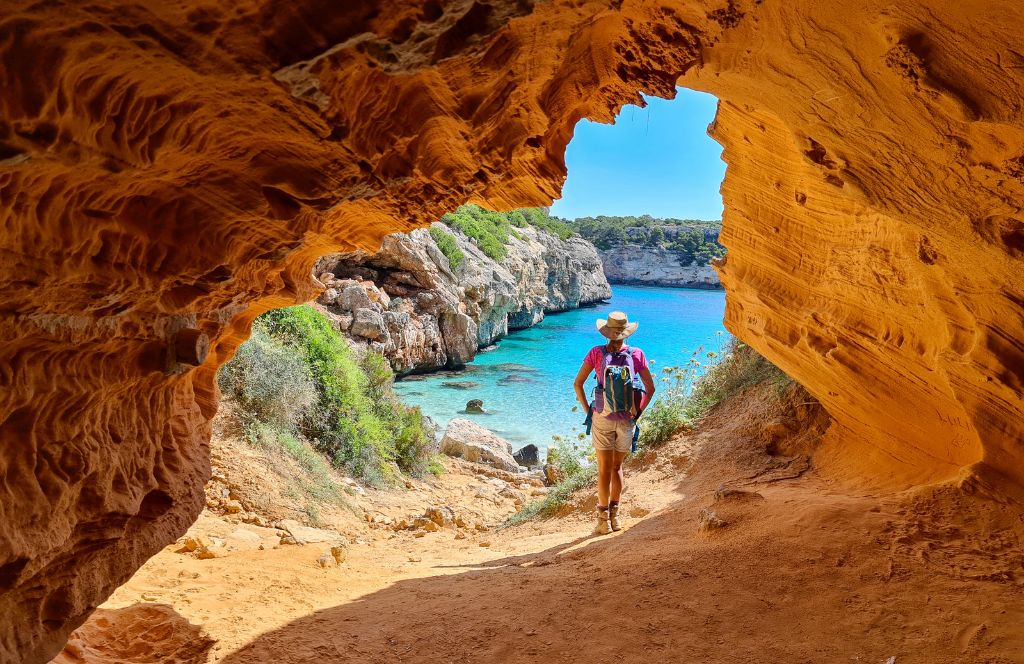
Mallorca works for almost any family setup. Playa de Palma has wide sandy beaches and calm water for small kids. Teens can try kayaking or paddleboarding along the coast (rentals from $18/hour). The Tramuntana Mountains on the northwest side of the island have hiking trails ranging from gentle (Cala Deià, 30 min) to challenging (Torrent de Pareis gorge). Palma city itself is worth a full day: the cathedral is striking, the old town has good tapas, and Bellver Castle is one of the few circular castles in Europe (entry $4, free on Sundays).
The Balearic ecotasa is the family-friendliest tourist tax structure in Spain: two kids under 16 pay nothing, and the rate drops 50% from the ninth night, so a 10-day stay costs barely more in tax than a 7-day one. Avoid Magaluf and the party strips south of Palma with kids. Stick to the north (Pollença, Alcúdia) or east coast (Cala Millor, Porto Cristo) for a calmer experience.
Where to stay: Mon Port Hotel and SPA, perfect for families, with spaces adapted for children, activities and playgrounds.
Budget for 1 week (family of 4): $2,200–3,600 including flights
3. Tenerife & Gran Canaria | Best for: Year-round family holidays, any age

Nearest airport: Tenerife South or Gran Canaria (Las Palmas), both 15–40 min transfer
Best months: Year-round (72–82°F)
2026 tourist tax: None in most of the Canaries; Mogán (Gran Canaria) charges a small local fee
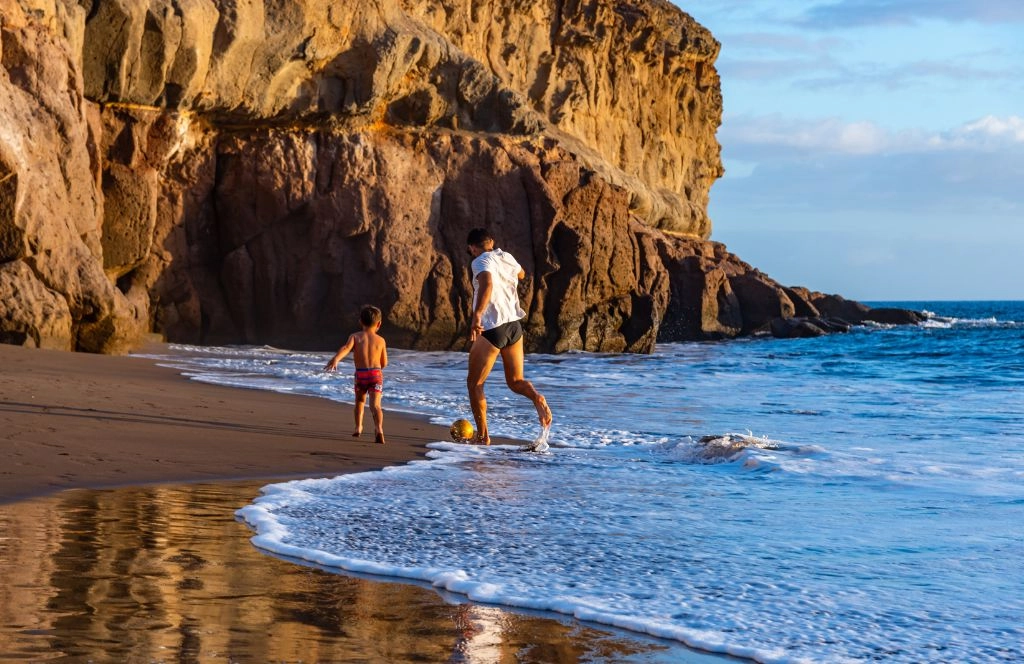
The Canary Islands are the most versatile winter family destination in Europe, and in 2026 they remain free of regional tourist tax. Tenerife's south coast (Playa de las Américas, Los Cristianos) has the resort infrastructure and sandy beaches. The north is greener, cooler, and less touristy. Teide National Park, where Spain's highest peak (3,718m) sits inside a volcanic crater, is a genuine day trip: the cable car to near the summit costs $45 for adults and $16 for kids.
Gran Canaria is the sister-island choice when Tenerife is fully booked. Maspalomas has protected sand dunes you can walk through like a mini-Sahara, Puerto de Mogán is a small harbour town with calm swimming beaches, and the north of the island (Las Palmas) is a proper Spanish city with museums and Las Canteras beach inside the urban core.
Siam Park in Tenerife is consistently ranked as one of the world's best water parks ($45 adults, $31 kids). Loro Parque in Puerto de la Cruz ($45/$31) combines zoo, aquarium, and botanical garden in one visit. Both are full-day outings.
Where to stay: Hard Rock Hotel Tenerife. Kids' club, family suites, multiple pools and a good beach below the hotel. From around $170/night.
Budget for 1 week (family of 4): $2,200–3,800 including flights
4. Valencia | Best for: Culture + beach, families with kids aged 5+

Nearest airport: Valencia (20 min to city centre)
Best months: April to October
2026 tourist tax: None: Valencia region scrapped its planned tax in 2024
Valencia is the best family city break in Spain that isn't Barcelona, and in 2026 it's dramatically better value. The City of Arts and Sciences complex is worth the trip alone: the Oceanogràfic aquarium (the largest in Europe, $40 adults, $30 kids) is a full morning, and the interactive science museum is another half-day. The old town has enough history and tapas bars to fill an afternoon, and the Malvarrosa beach is a 15-minute bus ride away.
The math works hard here: Valencia is roughly 40% cheaper than Barcelona for equivalent hotels, and it has no tourist tax. A family paella lunch in a beachfront restaurant near El Cabanyal costs around $50–65 for four, including drinks. The Turia Gardens, a 9km green park built in a former riverbed, is free, runs through the whole city, and is where locals take their kids on weekends.
Where to stay: Hotel Sorolla Centro. Central location, good-sized family rooms, and a 10-minute walk to the City of Arts and Sciences. From around $95/night.
Budget for 1 week (family of 4): $1,700–2,900 including flights
5. Barcelona | Best for: City breaks with kids aged 8+
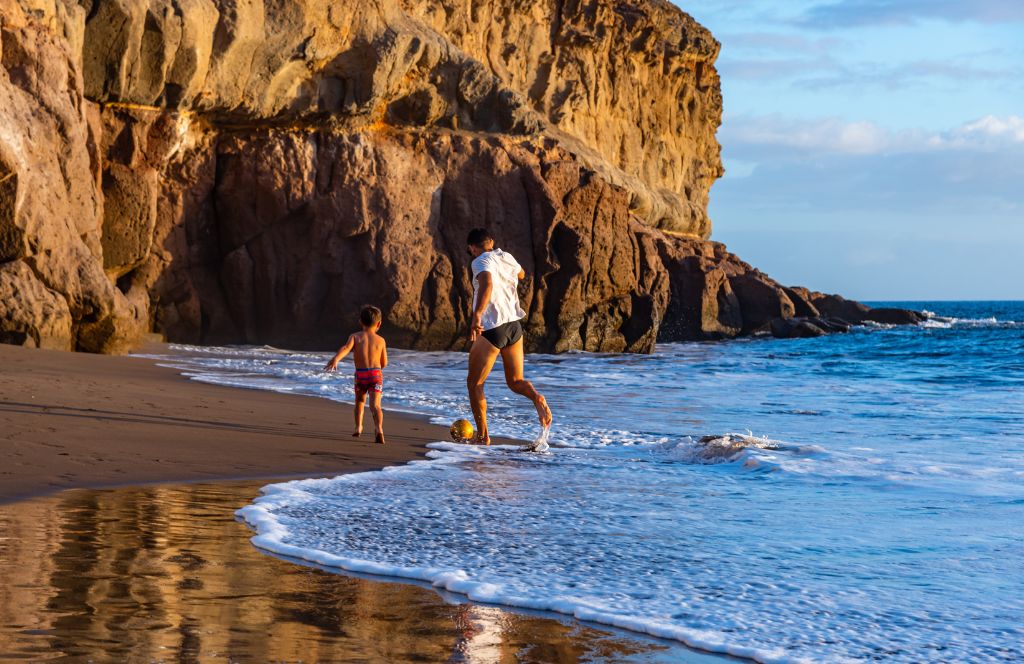
Nearest airport: Barcelona El Prat (30–45 min to city centre)
Best months: April to June, September to October (July-August is hot and packed)
2026 tourist tax: $8–$13 (€7–€12) per adult per night; under-16s exempt
Barcelona is still worth visiting, but 2026 requires more planning. The doubled tourist tax adds meaningfully to a long stay (a family of two adults + two kids in a 4-star hotel for 5 nights now pays around $91 (€84) in tax), and the short-term rental phase-out means apartment options are shrinking fast. The practical move is to book a licensed family hotel outside Ciutat Vella (Eixample, Gràcia, or the beachfront near Poblenou all work) and treat the Gothic Quarter as a half-day walk rather than a neighbourhood to stay in.
Gaudí's buildings still carry the trip. Park Güell ($12, free under 6) and the Sagrada Família ($31, free under 11), now structurally complete after 140+ years, remain visually striking enough that even teenagers pay attention. Barceloneta beach is a 15-minute walk from the centre.
For a break from the city, take the train to Montserrat (1h, $24 return for the rack railway), a monastery perched on a jagged mountain with views over half of Catalonia. The food market at La Boquería on Las Ramblas is good for lunch (smoothies, jamón, seafood): go early and watch your bags.
Where to stay: H10 Marina Barcelona. Rooftop pool, walking distance to the Gothic Quarter and the beach. From around $145/night.
Budget for a long weekend (family of 4): $1,300–2,400 including flights and tax
6. Costa Dorada | Best for: Theme park families with kids aged 4–14
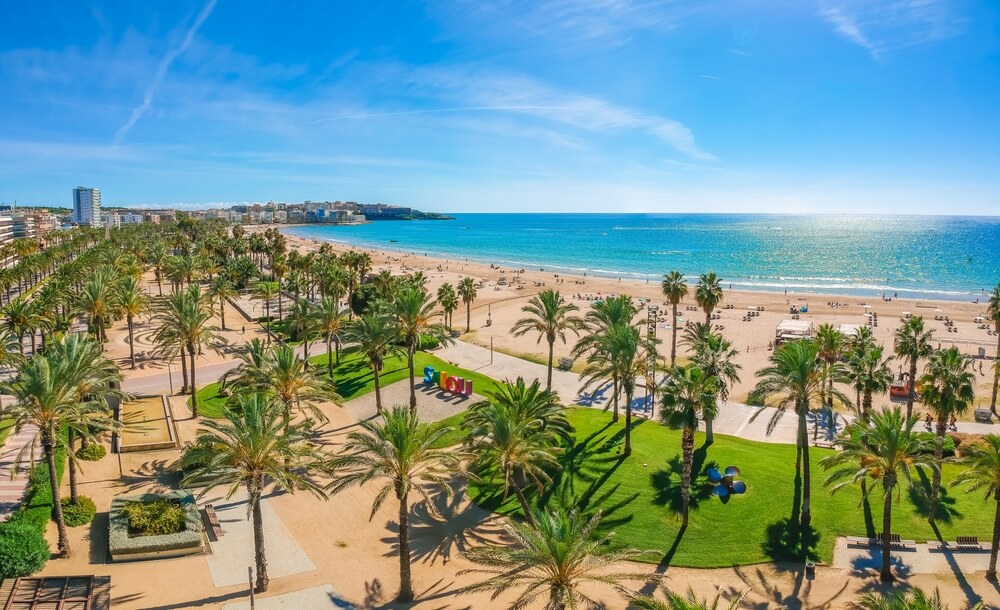
Nearest airport: Reus (15–30 min transfer) or Barcelona (1h 15 min)
Best months: June to September
2026 tourist tax: $1–$5 (€1–€4.50) per adult per night (Catalonia rate outside Barcelona); under-16s exempt
The Costa Dorada's main draw for families is PortAventura World, which includes PortAventura Park, Ferrari Land, and a water park. A 3-day pass costs around $115 for adults and $95 for kids. Beyond the park, the town of Salou has a long, gently-sloping sandy beach that works well for young swimmers, and the Roman ruins at Tarragona (30 min drive) are a free open-air history lesson.
The 2026 Catalan tax increase is much gentler here than in Barcelona: around $1–$5 (€1–€4.50) per adult per night depending on hotel category, with both kids exempt. For a family of two adults + two children staying a week at a 4-star, the tax is roughly $54 (€50) total.
Cambrils, 15 minutes south of Salou, is quieter and has better restaurants; it's known locally as the gastronomic capital of the coast. The beaches there are calmer and less crowded.
Where to stay: PortAventura Hotel Gold River. Wild West themed, inside the resort complex, with direct park access. From around $155/night.
Budget for 1 week (family of 4): $2,400–3,800 including flights and park tickets
7. Costa Brava | Best for: Active families with kids aged 6+
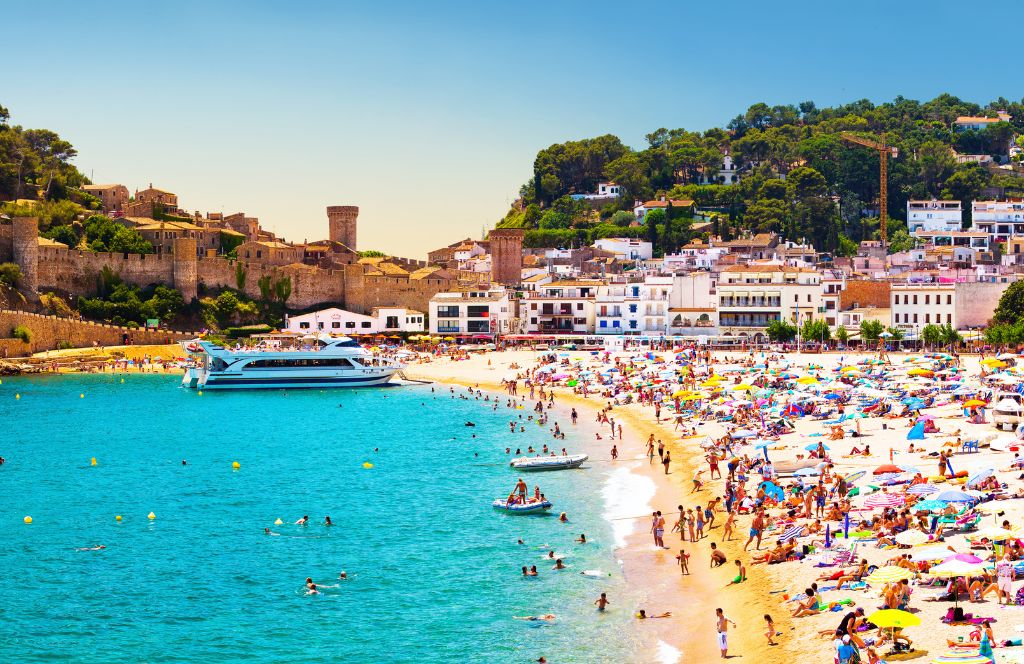
Nearest airport: Girona (20 min transfer) or Barcelona (1h 15 min)
Best months: June, September
2026 tourist tax: $1–$5 (€1–€4.50) per adult per night; under-16s exempt
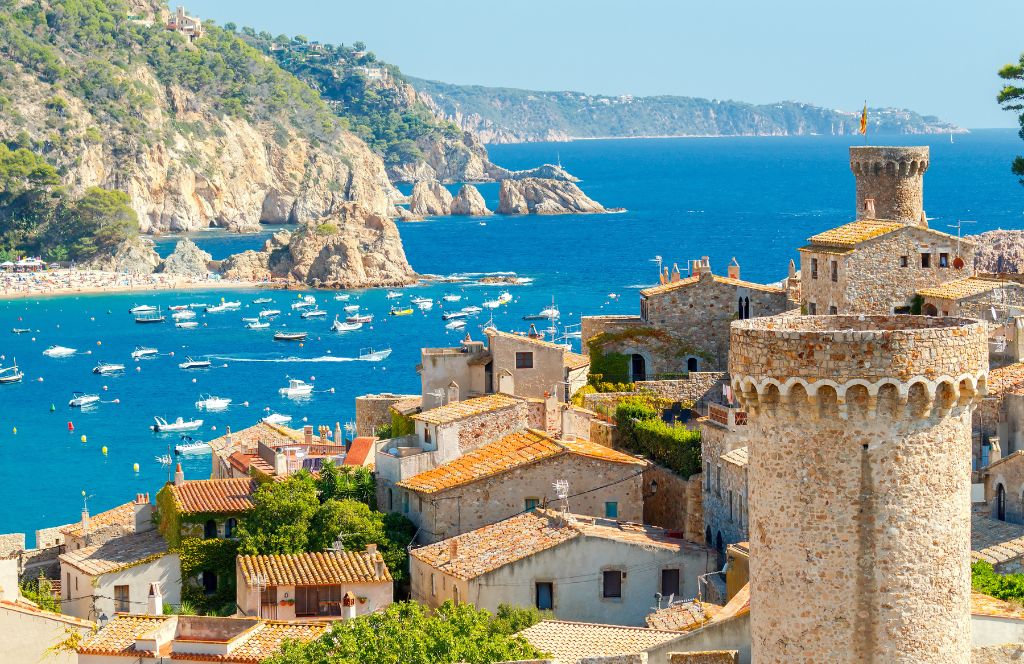
The Costa Brava is the opposite of a generic resort strip. The coastline between Tossa de Mar and Cadaqués is rocky, with coves you have to walk down to, and the water is clear enough for snorkelling straight off the beach. Lloret de Mar has the family infrastructure (water parks, promenade restaurants, mini-golf) while the medieval walled town of Tossa de Mar gives you a half-day of history without anyone complaining. Cap de Creus Natural Park has easy coastal hikes (2–3 hours) with views that keep older kids engaged.
The 2026 Catalan tourist tax applies here but at the lower non-Barcelona rate, and kids under 16 don't pay. The trade-off with the Costa Brava is geographical, not fiscal: beaches are smaller and rockier than the southern coasts, so if your kids are under 5 and need long stretches of sand, this might not be the best fit.
Where to stay: Meliá Lloret de Mar. Pool, close to the beach, and family rooms available. From around $110/night in summer.
Budget for 1 week (family of 4): $1,800–3,000 including flights
8. Costa Blanca | Best for: Budget beach holidays with toddlers
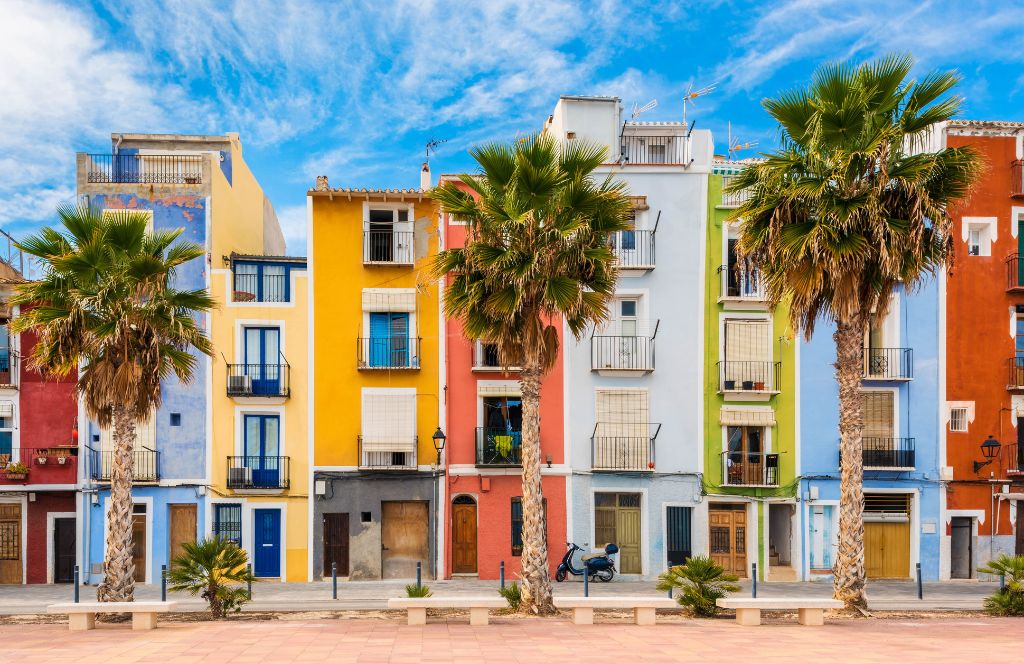
Nearest airport: Alicante (20–45 min transfer)
Best months: May to October
2026 tourist tax: None: Valencia region applies no tourist tax
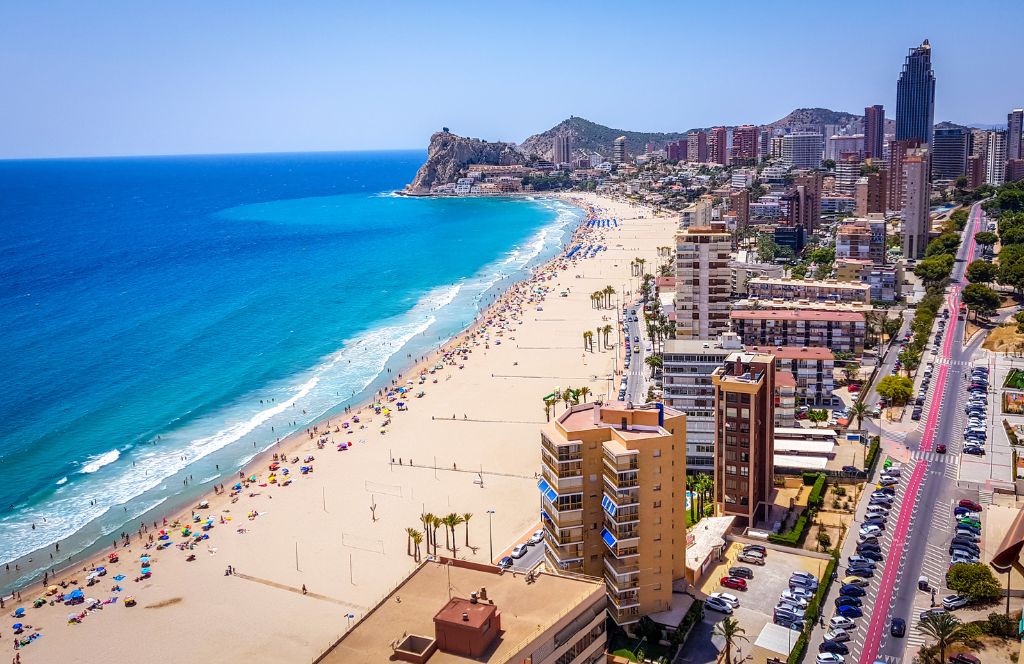
The Costa Blanca has some of the widest, shallowest beaches in Spain, ideal for small children who want to splash in ankle-deep water for hours. The zero-tourist-tax picture makes it even more attractive for price-sensitive families in 2026. Benidorm gets a bad reputation, but its Poniente beach (the quieter western side) is genuinely family-friendly, and the town has some of the cheapest holiday accommodation in the country. For something less built-up, Jávea and Calpe have clean beaches backed by mountains instead of tower blocks.
Terra Mítica theme park (tickets from $33) near Benidorm is themed around ancient civilisations; less polished than PortAventura but shorter queues. The mountain village of Guadalest (40 min from Benidorm) is free to wander and has castle ruins with views down to a reservoir.
Where to stay: AR Diamante Beach Spa in Calpe. Family rooms, direct beach access, pool and spa. From around $100/night.
Budget for 1 week (family of 4): $1,400–2,600 including flights. One of the cheapest options on this list.
9. Madrid | Best for: City breaks with kids aged 5+ and theme-park families
Nearest airport: Madrid-Barajas (30 min to city centre by metro)
Best months: April to June, September to October (summer hits 104°F)
2026 tourist tax: None: Madrid region applies no tourist tax
Madrid is the most overlooked Spanish city for family trips and it shouldn't be. Parque Warner Madrid (45 min from the city by train) is the country's only DC and Warner Bros. theme park: Batman rollercoasters, Looney Tunes areas for young kids, and a full water-park section in summer. A day ticket is around $45 for adults, $38 for kids.
In the city, Retiro Park is 350 acres of trees, a boating lake ($12 for a rowboat), and puppet shows on weekends. The Prado Museum is free for under-18s and free for everyone in the last two hours of each day, enough time to see the highlights without losing anyone. The Royal Palace ($15 adults, free under 5) is more engaging than it sounds: the armoury room alone keeps kids busy for 30 minutes.
Madrid's hotel prices are noticeably lower than Barcelona's for equivalent rooms, and with no tourist tax the gap widens further. Day trips to Toledo (30 min by high-speed train) or Segovia (25 min, home to a 2,000-year-old Roman aqueduct) give you medieval Spain without needing a car.
Where to stay: Central Madrid near Sol or Gran Vía for walkability; or a family aparthotel in Chueca/Malasaña for neighbourhood character.
Budget for a long weekend (family of 4): $1,200–2,100 including flights
10. Seville | Best for: Cultural city breaks with kids aged 10+

Nearest airport: Seville (20 min to city centre)
Best months: March to May, October to November (summer averages 97°F, too hot for sightseeing with kids)
2026 tourist tax: None: Andalusia applies no regional tax
Seville is the destination on this list that's least about beaches and most about culture, but it's included because it's one of the few Spanish cities where the atmosphere alone carries the experience. The Alcázar palace ($14, free under 14) has gardens that feel like a film set (Game of Thrones filmed here). The cathedral is the largest Gothic cathedral in the world, and climbing the Giralda tower (included in the $12 entry) gives you views over the entire city.
Flamenco in Seville is the real thing. Catch a show at La Carbonería (free, book ahead) or the Museo del Baile Flamenco ($17 adults, $12 kids). Tapas in the Santa Cruz neighbourhood are good and cheap: a plate of patatas bravas costs $3.50, and a full spread for four is around $38–50 with drinks.
Seville pairs well with a few nights in Granada (2h 30min by bus) for the Alhambra (book Alhambra tickets three months ahead, they sell out), giving you a strong Andalusian cultural loop with zero tourist tax on either city.
Where to stay: Las Casas de la Judería: a historic building in central Seville with architecture inspired by Andalusia's Arab and Jewish heritage. From $141/night.
Budget for a long weekend (family of 4): $1,100–1,900 including flights
Canary Islands vs mainland Spain: which is better for families?
The short version: choose the Canary Islands for winter trips, mainland for May to October.
The Canaries (Tenerife, Gran Canaria, Lanzarote, Fuerteventura) stay between 68°F and 77°F all year, don't apply a regional tourist tax in 2026, and have resort infrastructure specifically built around families: Siam Park, Loro Parque, Aqualand Maspalomas. Downside: flights from the US are longer (usually via Madrid or a European hub) and the islands feel less distinctly "Spanish" than the mainland, particularly in the big resorts.
Mainland Spain wins on variety, culture, and food. You can combine a beach week with a city stop (Málaga → Seville, Valencia → Madrid) in a way that isn't really possible on the islands. From May to October, mainland sea temperatures are warm enough for kids, and the difference in cultural depth is significant: Granada, Córdoba, Toledo, and Madrid all have the kind of depth the Canaries don't attempt.
For a first family trip with kids under 8, the Canaries win on logistics. For repeat visits, older kids, or mixed beach-and-culture families, mainland is usually the better call.
Quick comparison: which destination fits your family?
| Destination | Best age range | Budget (1 week, family of 4) | 2026 tourist tax | Main draw |
| Costa del Sol | Under 10 | $1,900–3,400 | None | Classic all-inclusive, Caminito del Rey |
| Mallorca | All ages | $2,200–3,600 | $2–$4 (€2–€4)/adult/night (kids free) | Best all-rounder |
| Tenerife & Gran Canaria | All ages | $2,200–3,800 | None | Year-round sun, Siam Park |
| Valencia | 5+ | $1,700–2,900 | None | Oceanogràfic, Turia Gardens, cheap paella |
| Barcelona | 8+ | $1,300–2,400 (weekend) | $8–$13 (€7–€12)/adult/night (kids free) | Gaudí, food, beach + city |
| Costa Dorada | 4–14 | $2,400–3,800 | $1–$5 (€1–€4.50)/adult/night (kids free) | PortAventura + beach |
| Costa Brava | 6+ | $1,800–3,000 | $1–$5 (€1–€4.50)/adult/night (kids free) | Coves, snorkelling, hiking |
| Costa Blanca | Toddlers | $1,400–2,600 | None | Cheapest beach option |
| Madrid | 5+ | $1,200–2,100 (weekend) | None | Warner Park, Prado, Retiro, day trips |
| Seville | 10+ | $1,100–1,900 (weekend) | None | Alcázar, flamenco, tapas |
Frequently asked questions
What is the best part of Spain for a family vacation?
For most US families, the Costa del Sol (Málaga province) offers the most consistent family infrastructure, reliable sun from April to October, and no regional tourist tax in 2026. For mixed ages, Mallorca is the strongest all-rounder. For winter trips, the Canary Islands (Tenerife and Gran Canaria) are the only Spanish destinations that stay beach-warm from December to March.
Is Spain expensive for a family vacation in 2026?
Compared to France or Italy, Spain is still very competitive. A family of four can expect a full week (flights, hotel, food, activities) from around $1,400–3,800 depending on the destination. The main cost increase in 2026 is in Catalonia (Barcelona specifically), where the new tourist tax adds $11–$16 (€10–€15) per adult per night at higher-end accommodation. Andalusia, Valencia region and the Canaries apply no regional tourist tax at all.
Are the Canary Islands better than mainland Spain for kids?
For winter trips (December to March), yes: the Canaries guarantee 68–77°F when mainland beaches are cold. Mainland is better value and logistics from May to October, and it offers much more cultural variety if you want to combine a beach stay with a city visit. For a first trip with young kids, the Canaries are easier; for older kids or repeat visits, mainland usually wins.
Do I need ETIAS for a Spain family vacation in 2026?
Not for most of 2026. ETIAS (the EU travel authorisation) launches in the last quarter of 2026, so check official sources before your trip. What does apply right now is the EES biometric system, live since 10 April 2026: on your first entry to Spain, every family member (including kids) has their fingerprints and facial image captured at the border. No fee, no advance registration, but allow an extra 45–90 minutes at arrivals during peak travel periods.
Is Barcelona family-friendly despite overtourism?
Yes, but plan around the new realities. Stay outside Ciutat Vella (Eixample, Gràcia, or beachfront Poblenou are better for families), avoid the Ramblas between 11am and 6pm in summer, and book a licensed hotel rather than a short-term rental: Barcelona is phasing out all tourist apartment licences by November 2028, so the legal apartment market is shrinking and often more expensive than hotels.
What's the cheapest time for a family vacation in Spain?
Late September and early October, after European school holidays end and before US Thanksgiving travel starts. Flights are typically 25–35% cheaper than July–August, sea temperatures on the Mediterranean coast are still around 72°F, and the big tourist crowds have thinned out. For winter, the Canary Islands in late January and February offer the best weather-to-price ratio.
Is Spain safe for families?
Spain is one of the safest countries in Western Europe for tourism. The main things to watch are pickpockets in Barcelona and Madrid (especially Las Ramblas and around major tourist sites), strong currents on some Atlantic-facing beaches, and the heat. Kids dehydrate faster than adults, so carry water and avoid outdoor activities between 1pm and 5pm in July and August.
Do I need a car for a family vacation in Spain?
It depends on the destination. Resort areas like the Costa del Sol, Costa Blanca, and Costa Dorada are walkable once you're there. For Mallorca (outside Palma), the Costa Brava, and the Canary Islands, a rental car opens up the best beaches and quieter spots. In Barcelona, Valencia, Madrid, and Seville, public transport and walking cover everything.
What age do kids fly free to Spain?
Infants under 2 fly for around 10% of the adult fare on most airlines (they sit on your lap). From age 2, children pay close to adult prices, though some budget airlines don't differentiate between adult and child fares.
Gift your family a vacation in Spain
Still deciding where to go? With a Flightgift card, your family can choose from over 400 airlines and 980 destinations worldwide, including every Spanish airport listed above. Pair it with a Hotelgift card and they'll have both flights and accommodation sorted, with the freedom to pick exactly when and where to go. Both cards are valid for 2 years, so there's no rush to book.